
Getting a Marriage License in Montgomery County
Marriage licenses in Montgomery County are issued by the Marriage License Department of the Probate Court. The office sits at 41 N. Perry Street, 2nd Floor, in Dayton, OH 45402. Hours run 8:30 a.m. to 4:15 p.m., Monday through Friday. Staff ask that you arrive by 4 p.m. so there is time to finish the paperwork. The license is the legal permission to marry, and it is good for 60 days from the day it is issued. If you do not use it in time, it expires and you start over.
There is one rule that trips people up. A lost or damaged marriage license cannot be replaced. The court does not reissue it. So keep it safe and dry until the ceremony. Both people must come in together and apply in person. No one can apply for an absent partner, and the court will not mail a blank application for you to send back.
One more point on the office itself. No one at the Probate Court can perform a wedding. The court only issues the license. The actual ceremony is handled by an officiant you choose, and that officiant must hold a license from the Ohio Secretary of State. You can reach the Probate Court Marriage License Department at 937-225-4400 with questions about hours, IDs, or what to bring.
How to Apply for a Marriage License
The application is short, but a missing document can send you home. Plan the trip so both people are free at the same time and have valid ID in hand. The Probate Court spells out the process clearly, and the steps below follow it.
- Confirm who is eligible. At least one person must live in Montgomery County, unless neither of you is an Ohio resident and the ceremony will take place in the county.
- Gather a valid picture ID for each person, and bring proof of Montgomery County residence if your ID does not show the address.
- If either of you was married before, bring the most recent divorce decree, or a death certificate if a former spouse died.
- Both people go together, in person, to the Probate Court Marriage License Department before 4 p.m.
- Fill out the application with the deputy clerk and give your Social Security numbers, which are used for ID only.
- Pay the $75 fee, plus any card or ACH convenience fee if you do not pay by cash.
- Use the license within 60 days and have a licensed Ohio officiant perform the ceremony.
- The officiant returns the signed certificate of verification to the court within 30 days of the ceremony.
The whole visit is usually quick once you have the right papers. The bottleneck is almost always a forgotten ID or a missing prior-marriage document, so check that list twice before you go.
Montgomery County Marriage License Resources Online
The Probate Court keeps the full requirement list and fee details on its own site, which is the safest place to confirm rules before you go. The county lays out the marriage-license steps on the Montgomery County Probate Court marriage page, including ID rules and payment options.
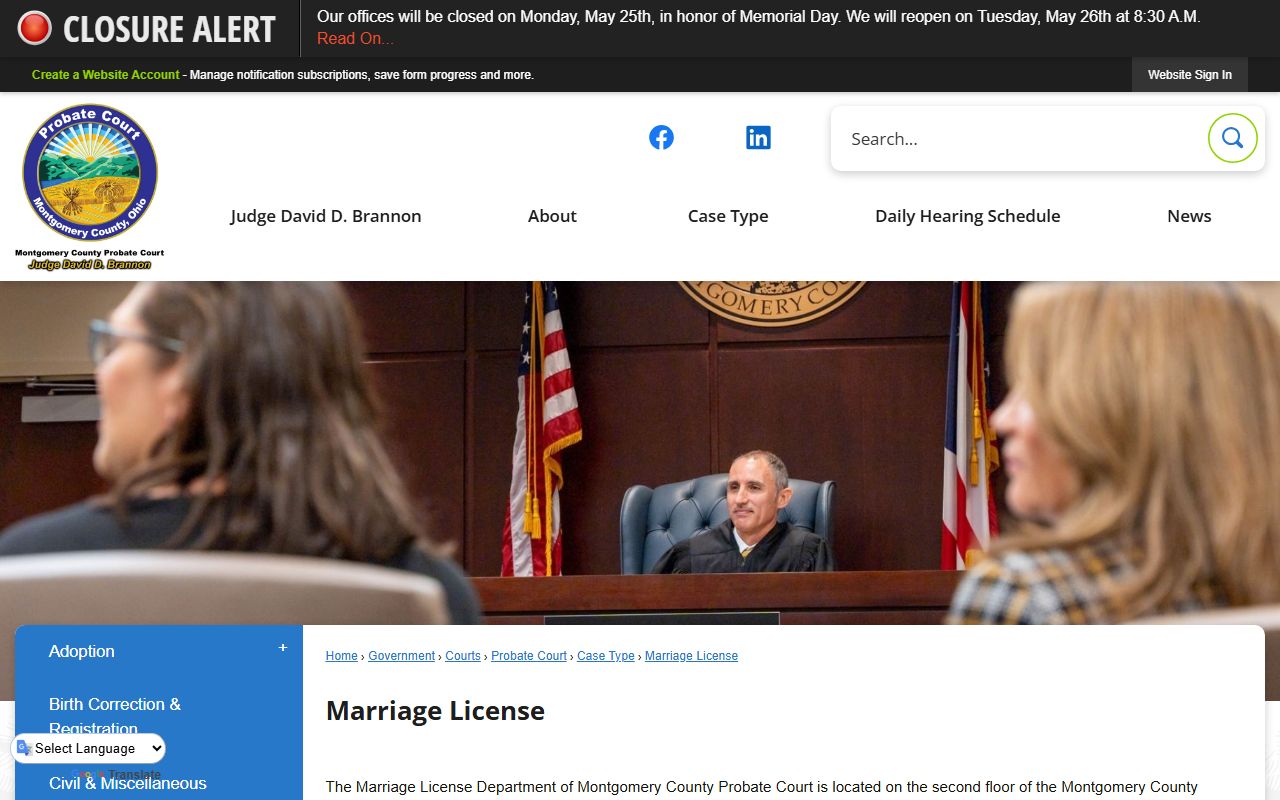
That page is the source for the $75 fee, the 60-day window, and the list of accepted IDs. It updates when the court changes a rule, so treat it as the final word over any printed flyer.
The marriage license itself is governed by state law, not just county practice. You can read the application and age provisions in the Ohio Revised Code section 3101.05, which sets the framework every county follows.
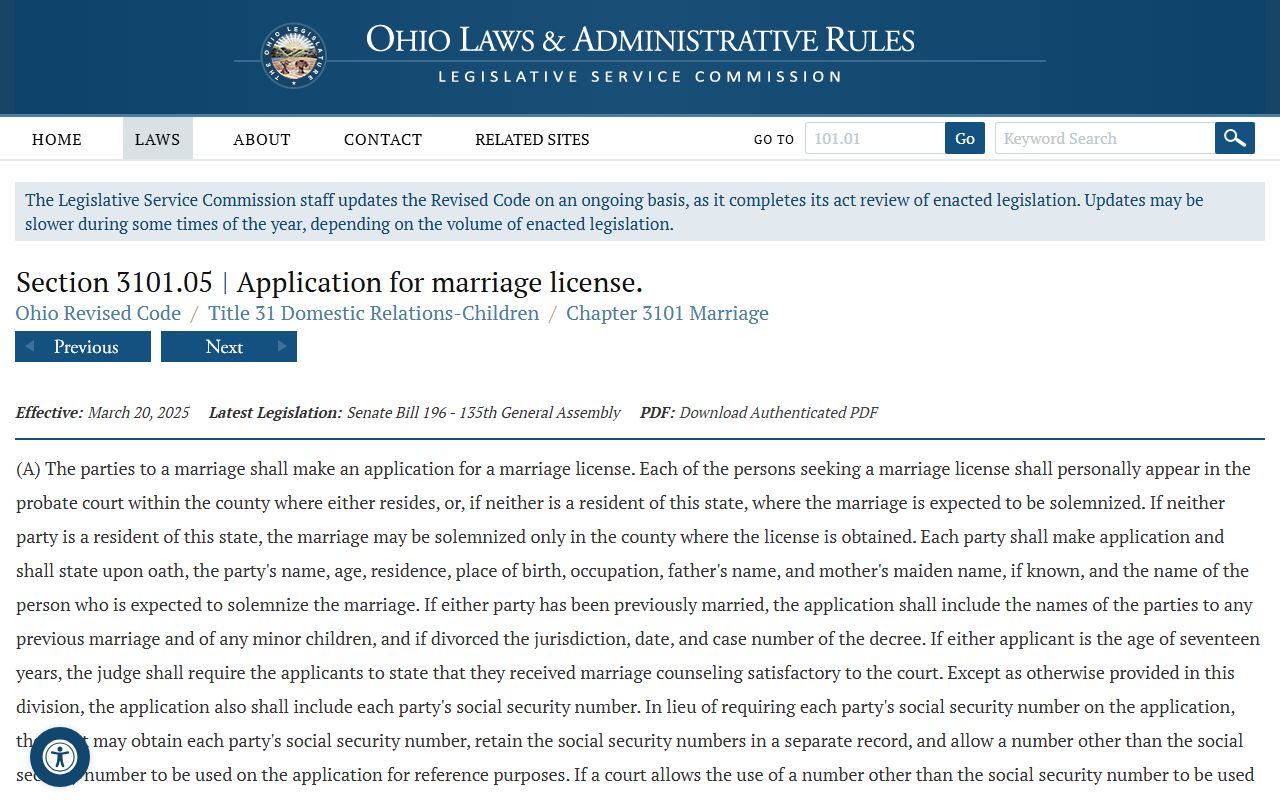
The statute explains who may apply and how age rules work. Montgomery County applies these same standards at the local counter.
Marriage License Application Requirements
The application asks for basic facts and a few documents. Most of it is about proving who you are and clearing any past marriage. The table below breaks down what each person needs to bring and why it matters.
| Requirement | Detail |
|---|---|
| Both parties in person | Both people must apply together at the counter; no proxy or mail application. |
| Valid photo ID | Driver's license, state ID, or INS visa for each person. |
| Social Security number | Used for ID only and kept confidential; the card is not needed if you know the number. |
| Birth certificate | Not required. |
| Residency | At least one party must live in Montgomery County, unless neither is an Ohio resident and the wedding is in the county. |
| Proof of residence | Needed if your ID does not show a Montgomery County address; a utility bill, lease, pay stub, or auto registration works. |
| Minimum age | 18 without parental consent; a 17-year-old exception packet exists through Probate. |
| Prior marriage documents | Most recent divorce decree if divorced, or a death certificate if a former spouse died. |
| Officiant | Must be licensed by the Ohio Secretary of State; court staff cannot perform ceremonies. |
For prior-marriage paperwork, two phone lines help. Questions about a Montgomery County divorce decree go to Domestic Relations Court at 937-225-7590. For a death certificate on a death in the county, call the Department of Vital Statistics at 937-496-3117.
Montgomery County Marriage and Divorce Fees
The marriage license has a flat fee, but how you pay can add a small charge. Cash is the cleanest option since cards carry a convenience fee. The court accepts cash, money order, and cashier's check at face value, and takes major cards with the added fee shown below.
| Item | Amount |
|---|---|
| Marriage license | $75 |
| Cash, money order, cashier's check | Accepted, no added fee |
| Credit card convenience fee | 2.3%, minimum $2 |
| Debit card convenience fee | $2.95 |
| ACH convenience fee | $0.50 |
Divorce costs are a different matter and depend on the case type and filings. Filing fees, certified decree copies, and any service charges are handled through the court and the Clerk of Courts rather than the Probate Court. Those amounts are set by the court schedule at the time you file.
Note: A marriage license fee and a divorce filing fee are two separate things paid to two different court divisions.
How to Look Up Montgomery County Marriage Records
Marriage license records are kept by the Probate Court, the same office that issues them. If you need to confirm a marriage or get a certified copy of the certificate, that is where the file lives. You can call the Marriage License Department at 937-225-4400 to ask how to request a copy and what proof of identity is needed.
To find a record, it helps to know the full names used on the license, the rough date of the marriage, and the year it was issued. Older records may take longer to pull. Because the license itself cannot be replaced once lost, a certified copy from Probate is the document people order when they need proof for a name change, a passport, or benefits.
How to Find Montgomery County Divorce Records
Divorce is handled by the Domestic Relations Court, not Probate. That court is at 301 W. Third Street, 2nd Floor, in Dayton, OH 45422-2160. It hears divorce, dissolution, legal separation, annulment, protection orders, spousal support, child custody, parenting time, and child support. The case file from any of those proceedings is where the divorce record lives.
Most people search those files online through the Clerk's PRO system. The portal lets you look up cases by name and filter by type. Use these steps to narrow a search.
- Open the Clerk PRO public records search and choose a name or case-number search.
- Pick the matching case type: Divorce, Dissolution of Marr., Annulment, or Legal Separation.
- Narrow further by action type, such as Divorce With Children, Divorce Without Children, Dissolution With Children, or Dissolution Without Children.
- Open the case to view the docket, parties, and filed documents.
A divorce file shows the parties, the case number, filing dates, motions, hearings, and the final decree. Some details get sealed, such as certain financial records or matters involving minor children, so not every page in a case is public. For the wider case database that feeds these searches, see Montgomery County court records.
Montgomery County Divorce Self-Help Portal
Filing a divorce or dissolution without a lawyer is hard, so the Domestic Relations Court runs a self-help portal with forms and step-by-step guidance. It covers starting a case, protection orders, completing a final order, changing an existing order, enforcing an order, service, and finding a lawyer. You can explore the tool through the Montgomery County Domestic Relations self-help portal.
The portal walks through each filing path in plain language, which is useful before you ever set foot in the courthouse. The main hub for those tools is the Domestic Relations self-help site.
Whether the court can hear your case at all turns on residency and jurisdiction. The rules sit in the Ohio Revised Code section 3105.03, which sets how long you must live in Ohio before filing.
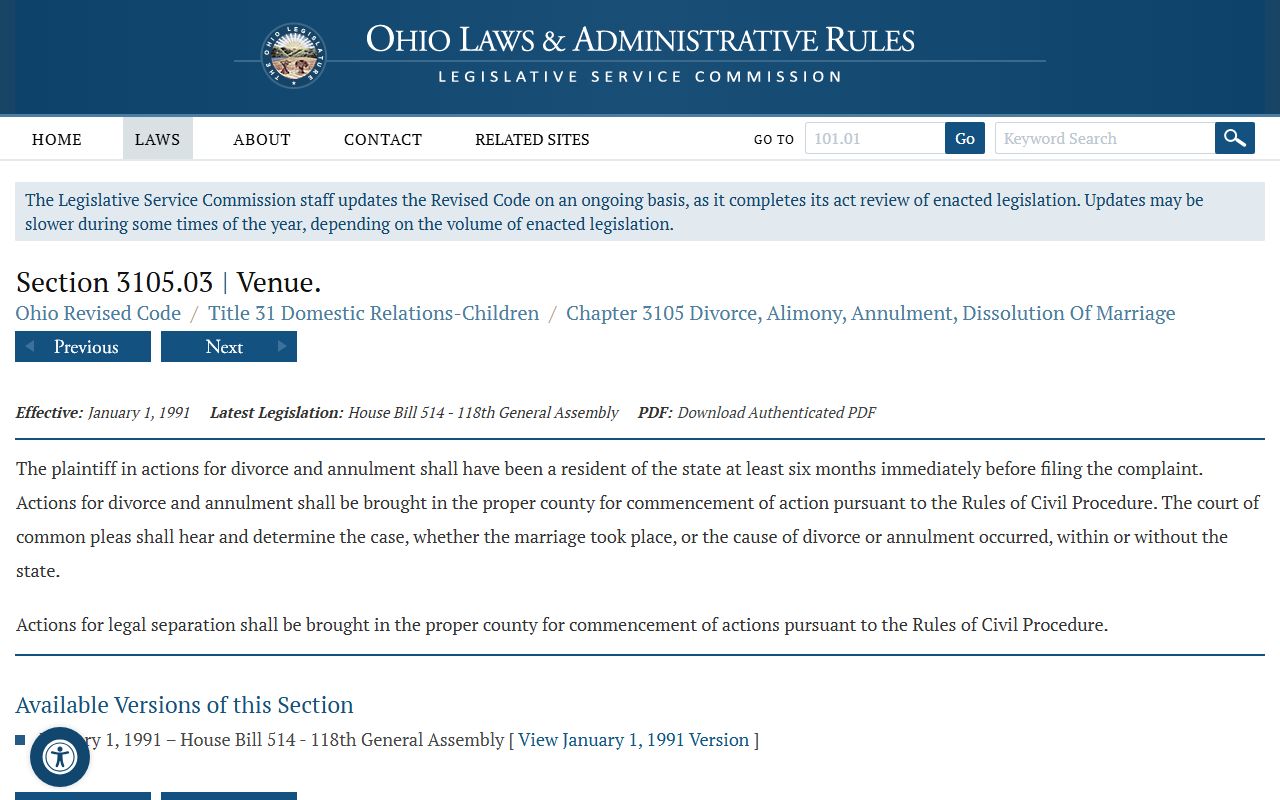
Confirm you meet that residency test first, since a case filed in the wrong place gets dismissed. The portal points you toward the correct court once you know you qualify.
Getting Certified Copies of Montgomery County Records
Plain printouts work for personal reference, but courts, banks, and agencies usually want a certified copy. For a marriage record, that certified copy comes from the Probate Court. For a divorce decree, the certified copy is routed to and issued by the Clerk of Courts.
The Clerk's Records Section pulls certified divorce decrees and other case documents. You will need the case number or the full party names and the year. To request a copy or check the cost, the Clerk of Courts page covers how the Records Section processes orders. For a wider view of what the county releases to the public, the public records page is a good next stop.
Note: An uncertified copy printed from an online portal is not a substitute for a certified copy in legal or official matters.
Legal Help for Montgomery County Marriage and Divorce
Not everyone can afford a lawyer, and a divorce with children or property can get complicated fast. Two statewide resources help fill the gap. One gives free legal information and forms, and the other can connect you with an attorney.
Ohio Legal Help offers plain-language guides on family law, divorce, and protection orders at no cost. Start at Ohio Legal Help to read through your options before you decide how to file.
The site sorts topics by life event, so the divorce and custody sections are easy to find. It pairs well with the county self-help portal.
If you want a lawyer, a referral service can match you with one. The Ohio State Bar Association runs lawyer referral and public legal information for the whole state.

A short consult can clear up whether you need full representation or just advice on a few forms. Many family-law questions are settled in one meeting.