
The Ohio Public Records Act and Montgomery County
Open records in Ohio run on one main law. The Ohio Public Records Act sits at Ohio Revised Code 149.43, often called the Sunshine Law. It says public offices must let people inspect records during normal business hours and must provide copies within a reasonable time. Montgomery County explains the rule in plain terms on its own page, and that page is the right starting point for anyone new to the process.
The county lays the act out for the public. You can read its summary on the Ohio Public Records Act page, which breaks down what a record is and how an office must respond. The screenshot below comes from that county page.
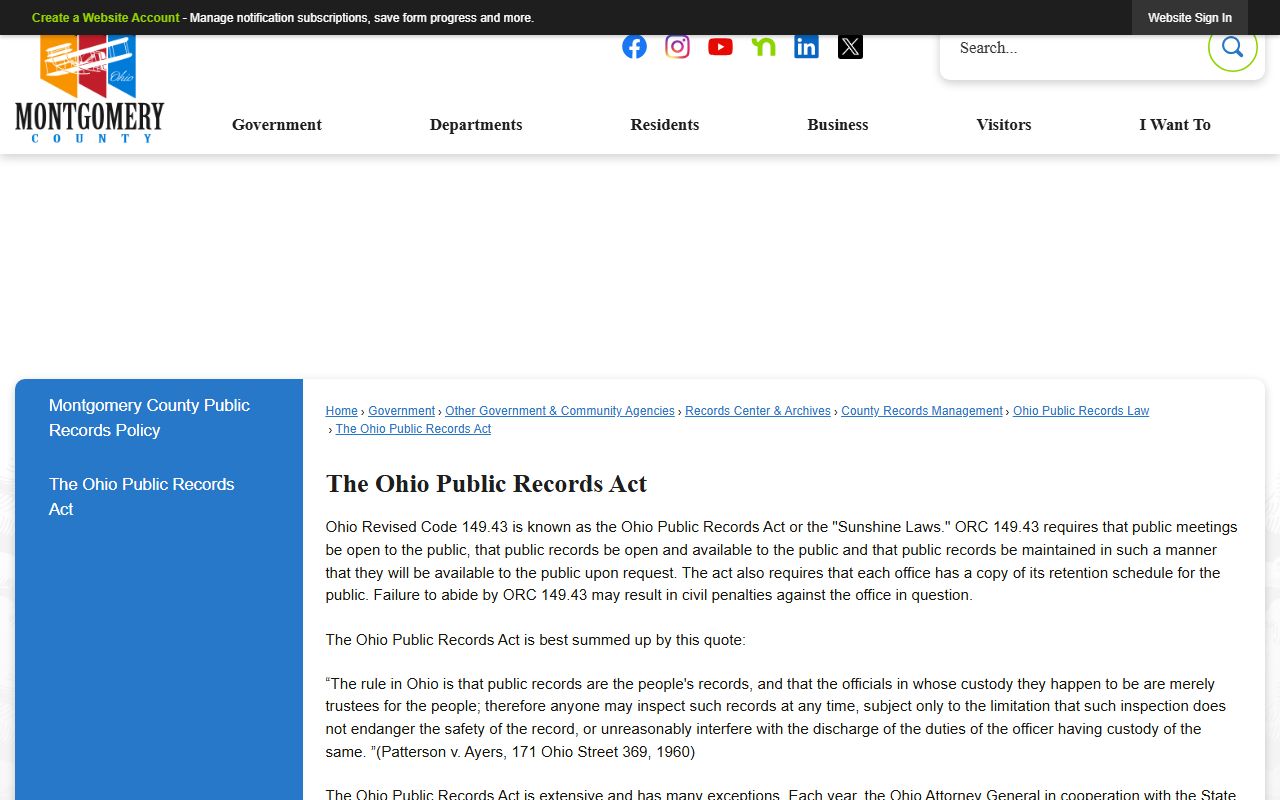
That page makes the access rule clear and points to the right county contacts. It is the plain-English version of the statute.
Requesters get strong rights here. Under the county's reading of the act, you do not have to give your name. You do not have to put the request in writing, though writing helps. And you do not have to say why you want the record or how you plan to use it. The one thing you must do is describe the record well enough that staff can find it. A vague or overly broad request can be denied, but the office must give you a chance to revise it.
Records the County Holds and Who Keeps Them
Montgomery County does not store its records in one place. Different offices keep different files, and each one answers its own requests. The county maintains a central page that routes you to the right custodian based on what you need. That routing step saves time, because sending a request to the wrong office only slows things down.
The county's main records page sorts requests by type. You can see how it directs people on the Montgomery County public records page, which lists the offices and the kinds of records each one holds. Here are the common custodians and what they keep:
- Clerk of Courts: court case files for Common Pleas, Municipal Court, and the Second District Court of Appeals.
- Probate Court: estates, guardianships, adoptions, name changes, and marriage licenses.
- Sheriff's Office: incident reports, jail records, and law-enforcement video.
- Recorder: deeds, mortgages, liens, and other land records.
- Public Health, Treasurer, and the Records Center: vital data, tax files, and archived historical records.
Court records carry an extra layer. Beyond the Public Records Act, they also fall under the Ohio Rules of Superintendence 44 through 47. Those rules set a presumption of public access, define personal identifiers, and limit what can be viewed remotely versus at the courthouse. So a court file may be open in full at the clerk's counter but redacted or hidden in the online system.
Montgomery County Public Records Rules
The county keeps a second reference page on the broader records law. It links Chapter 149 and explains record retention, which controls how long an office must keep a file before it can be destroyed. Retention matters because a very old record may already be archived or, in some cases, lawfully gone.
You can review the county's framework on the Ohio Public Records Law page. The image below is taken from that page.
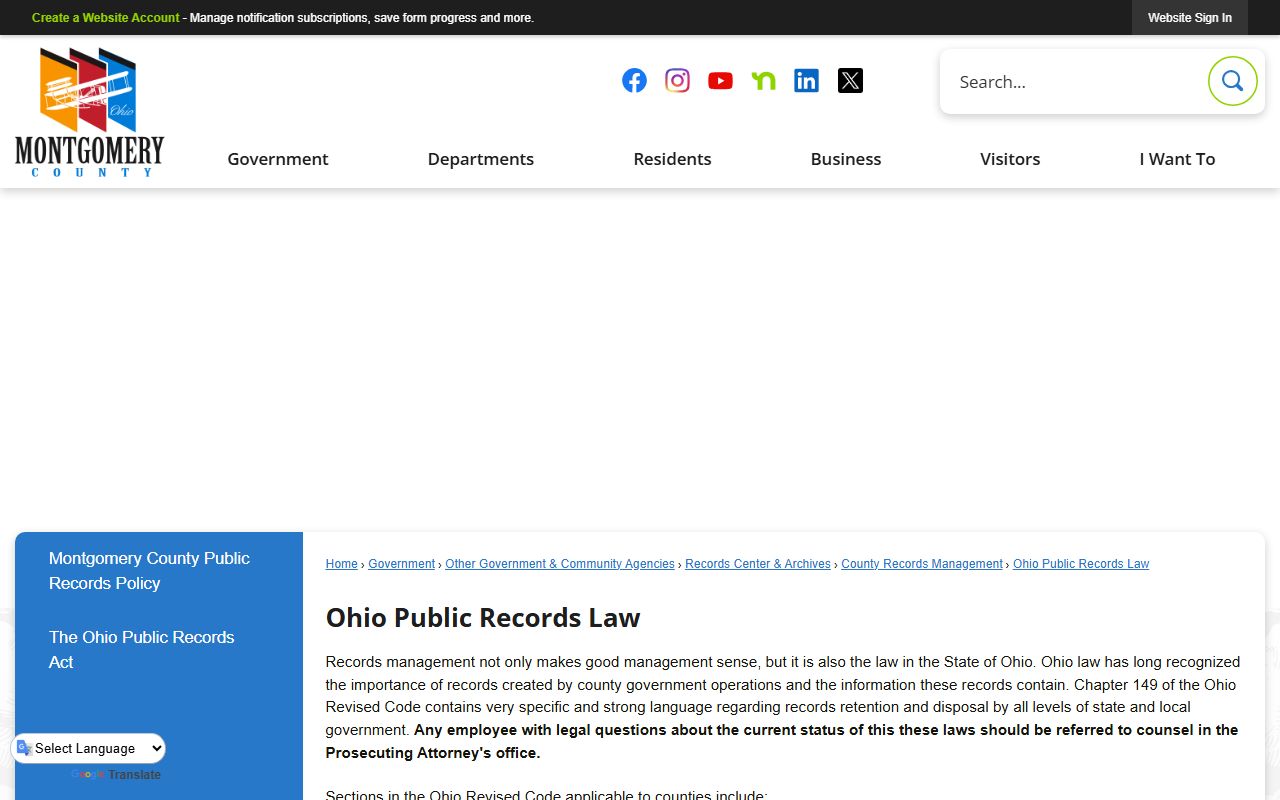
That page ties the county's practice to the state statute and the retention schedules behind it. It is useful when a request involves older files.
One practical note on inspection. The act treats inspection and copying as two different things. You can ask to look at a record without paying anything, since inspection on site is free. A fee only attaches once you ask for a copy. If you only need to confirm a fact, asking to inspect first can save money.
How to File a Montgomery County Public Records Request
Filing a request is not hard, but the order of steps matters. Start by figuring out which office holds the record, because that decides where the request goes and what it costs. The county routing page helps with that first step. After that, you describe the record, pick a delivery format, and send it in.
- Identify the custodian. Use the county public records page to match your record type to the right office, such as the Clerk, the Sheriff, the Recorder, or Probate.
- Describe the record clearly. Give names, dates, a case number, an address, or any detail that helps staff find the exact file. You do not need to state who you are or why you want it.
- Pick how you want it. Tell the office whether you want to inspect on site, get paper copies, get a CD, or receive the file by email.
- Submit the request. Send it in person, by mail, or by email to the office that holds the record. The Sheriff uses an online portal for its requests.
- Get the response. The office produces the record within a reasonable time, gives you any cost in advance, and cites legal authority if it denies any part.
Most offices accept a request by phone, email, or letter. A written request creates a record of what you asked for, which helps if there is a dispute later. But the office cannot require writing as a condition of access.
What to Include in a Records Request
There is no required form for a basic request, and you never have to use one. Still, giving the right details up front speeds the search and lowers the chance of a denial. The table sorts what helps from what the law actually requires. Only the record description and a way to reach you are truly needed.
| What to Include | Required | Notes |
|---|---|---|
| Record description | Yes | Be specific enough that staff can find the file: names, dates, case or parcel numbers. |
| Contact for delivery | Yes for copies | An address, email, or phone so the office can send the record or quote the cost. |
| Format wanted | No | Paper, CD, or email. The act lets you pick a format the office can produce. |
| Department or custodian | Helpful | Naming the right office routes the request faster and avoids transfers. |
| Requester name and purpose | No | Not required under the Public Records Act. You may stay anonymous. |
Note: a request that is too broad can be denied, but the office must explain how to narrow it and cannot just reject it without that help.
Montgomery County Public Records Fees
Copy costs in Montgomery County are low and tied to actual expense. The act bars an office from charging for the time staff spend pulling a record, so what you pay covers the copy itself. Paper copies run ten cents a page. A record burned to a disc costs one dollar. Files sent by email carry no charge at all. If you ask for records by mail, you cover the real cost of postage and supplies.
| Item | Cost |
|---|---|
| Paper copies | $0.10 per page |
| Records on CD | $1.00 per disc |
| Records emailed | No charge |
| Records mailed | Actual postage and supply cost |
| Sheriff law-enforcement video | Up to $75 per hour, $750 max |
Video is the one place where costs climb. Law-enforcement video takes time to retrieve, review, and redact, so the act lets the Sheriff charge for that work. The fee runs up to seventy-five dollars an hour with a cap of seven hundred fifty dollars per request. More on that office sits in the next section.
Montgomery County Sheriff Public Records
The Sheriff's Office handles its own public records and uses an online portal to take requests. Reports, jail data, and video all run through that office. Its records counter sits at 345 W. Second Street in Dayton and is open weekdays from 8 a.m. to 3 p.m. The office posts its fees and rules on a dedicated page.
You can read the rules and the fee schedule on the Sheriff's public records page. The screenshot below is from that page.
That page explains what the Sheriff releases and what it must withhold or redact. It also points to the request portal.
The Sheriff takes requests through NextRequest, an online system that tracks each request from start to finish. You file, the office logs it, and you watch its status as staff pull and review the records. Submit a request at the Sheriff's NextRequest portal, shown below.
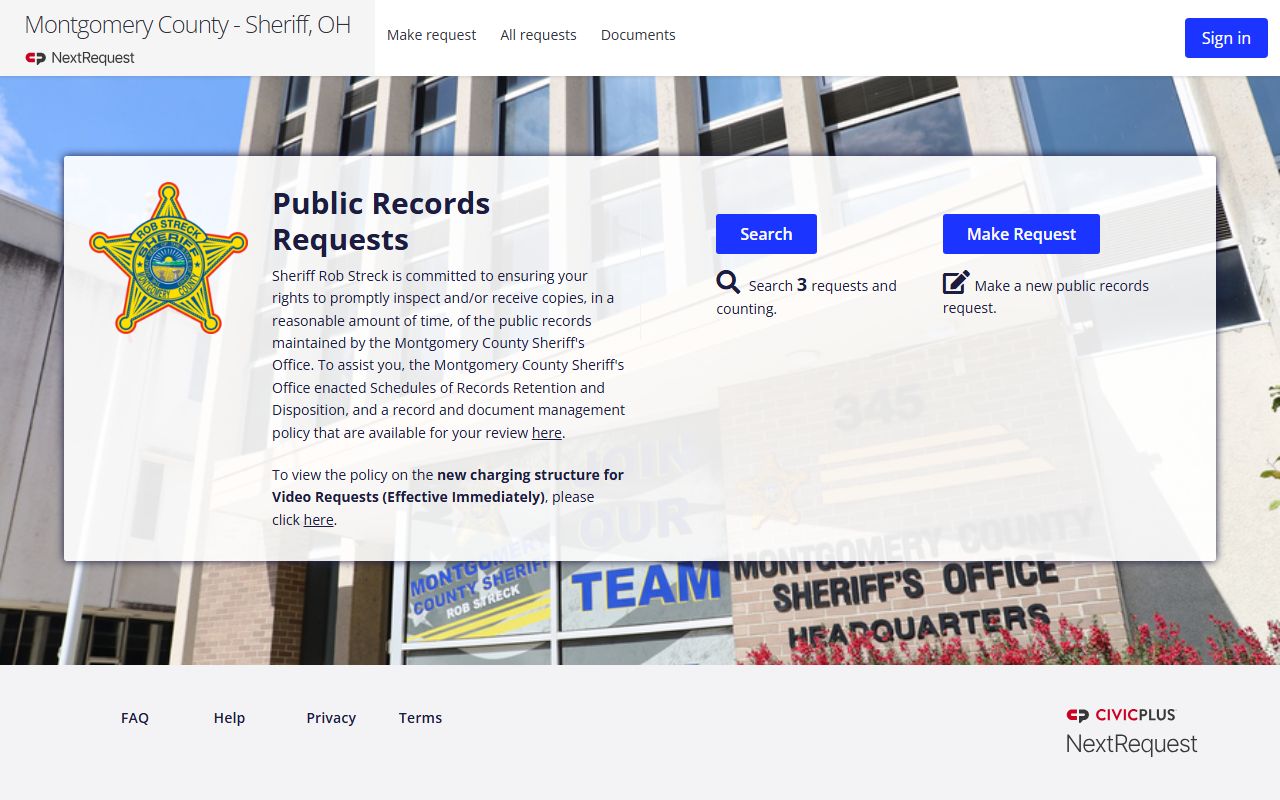
The portal gives each request a number and a timeline, so you can check progress without calling. It is the fastest route for sheriff and jail records.
Court Records Versus Agency Records
Not every public record works the same way. Agency records, like a sheriff report or a deed, fall under the Public Records Act alone. Court records answer to that act and to the Ohio Rules of Superintendence. The second set of rules can limit what shows up online even when the file is open at the courthouse.
This split matters in practice. The online court system may redact personal identifiers or hold back documents that the courthouse counter would show you in full. So if an online search comes up short, the clerk's office may still have the record. For full court files, start with court records or the Clerk of Courts. Estate and marriage files go through Probate Records.
The same logic shapes other record types. Arrest and booking data appears on criminal records, while divorce decrees and case files run through marriage and divorce records. Each page points to the office that actually holds the file.
Records That Are Confidential in Montgomery County
Some records stay closed by law. The Public Records Act has exceptions, and several Ohio statutes wall off sensitive files. A denial of these records is proper, not a refusal to follow the law. The office must still cite the exact authority when it withholds something.
The categories below are commonly confidential or redacted in Montgomery County:
- Juvenile court records, restricted under Ohio Revised Code 2151.14.
- Adoption and mental-health files held by the Probate Court.
- Protection orders that could reveal a protected person's identity.
- Sealed and expunged criminal records.
- Children Services case files and personal identifiers like Social Security numbers.
When only part of a record is confidential, the office cannot withhold the whole thing. It must redact the protected parts and release the rest, along with an explanation of what was hidden and why.
Denials and Redactions
An office can deny a request, but it cannot do so in silence. The Public Records Act says any denial must come with an explanation and a citation to the legal authority behind it. If the office relies on a statute or a court rule, it has to name it. That rule keeps offices honest and gives you something to challenge.
Partial denials follow the same path. When a record holds both open and closed material, the office redacts the closed parts and hands over the rest. It must tell you what it removed and which law allowed the removal. A flat refusal without a reason is not allowed under the act.
If you think a denial is wrong, Ohio gives you ways to push back, including the Court of Claims mediation process for public records disputes. Keep your written request and the office's response, since both help if you need to escalate.
The Records Center and Archives
Older county records may not sit in a current office at all. The county keeps historical files at its Records Center and Archives, housed in the historic Reibold Building. This is where you go for deep research into records that active offices have long since transferred. The center has its own location and access rules.
The archives sit at 117 S. Main Street on the 6th floor in Dayton. The county gives specific directions for finding it inside the building, since the elevators and entrances can confuse first-time visitors. For genealogy, historical deeds, or old case files, this is often the right stop after the active custodian comes up empty.
For a quick recap of the offices covered here, court records live with the Clerk, sheriff and jail files run through NextRequest, and aged or transferred records may rest at the archives. Matching the record to the office is the whole game with public records.